

On fearful-avoidant attachment, C-PTSD, and the long work of learning to stay
There once grew a tree in a forest where the weather changed without
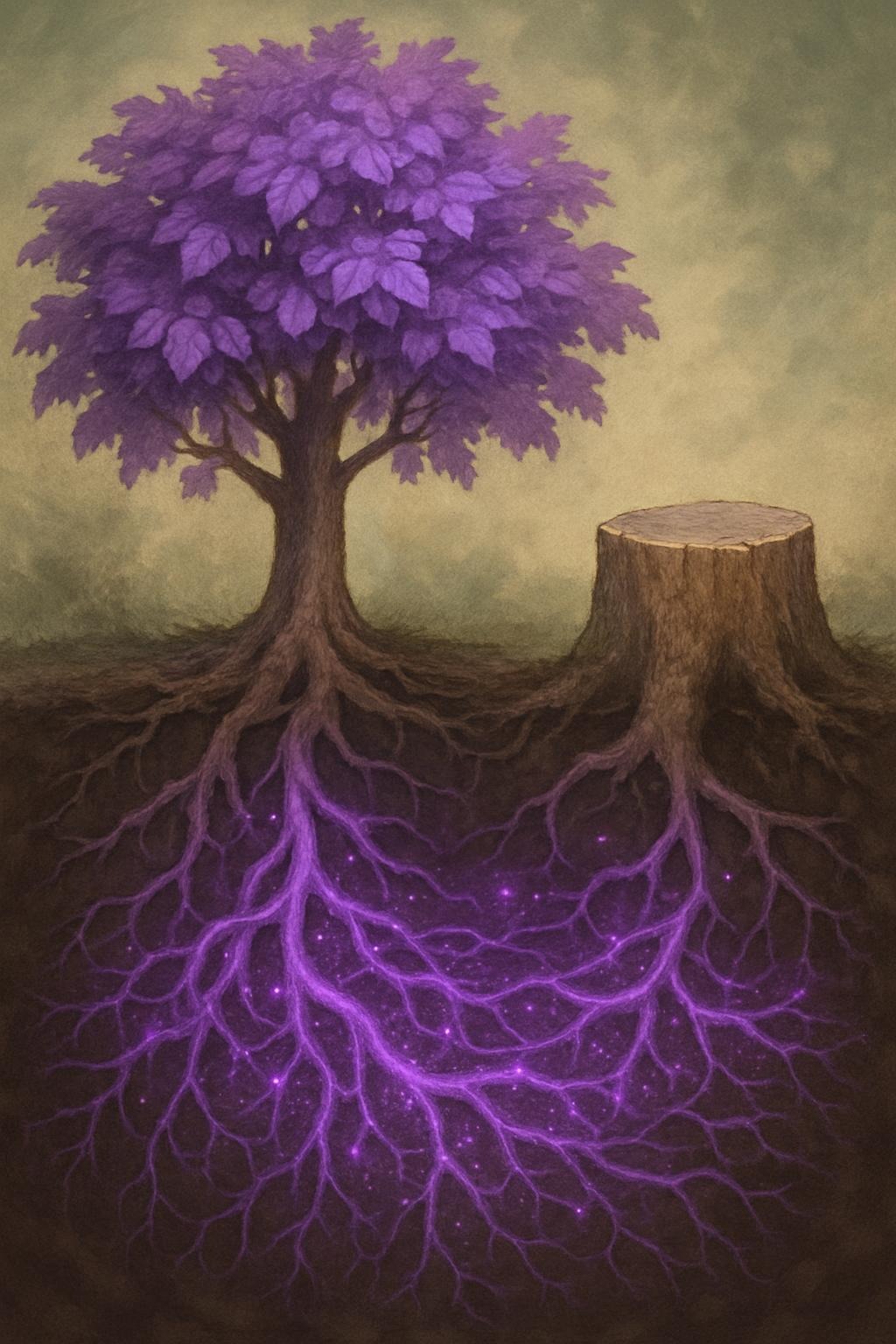
warning. The tree was strong and generous, its branches wide and welcoming. But beneath the soil, something unusual was happening. Through the vast underground network of mycelium—those threadlike highways that connect root to root in silent communion—this tree was sending nearly all its nutrients to a dying stump nearby. Water. Minerals. Sugars carefully synthesized from sunlight. All of it flowed away from the tree’s own heartwood, toward something that could not give anything back.
The tree didn’t think about this consciously, the way trees don’t think. It
simply did what it had learned to do in order to survive in a forest where love
and danger often wore the same face.
Some nervous systems grow up in landscapes like this. Where survival
requires both giving everything and keeping distance. Where closeness keeps you alive, and closeness puts you at risk.
This is the terrain where fearful-avoidant attachment and Complex PTSD
often take root, intertwined like the very mycelium beneath the forest floor—not separate problems, but survival adaptations shaped by environments that taught contradictory truths.
Complex PTSD develops in response to prolonged, repeated trauma—
especially relational trauma—where escape was not possible. It emerges not from a single terrible storm, but from living season after season in a climate where calm could turn to chaos in an instant.
The nervous system adapts. It becomes hypervigilant, learning to read the
subtlest shifts in atmospheric pressure. It develops a kind of empathy born from necessity—the ability to sense mood and threat in the tilt of a head, the pause before a word, the quality of silence. The body learns to mobilize quickly: fight, flight, freeze, or fawn. Whichever strategy kept you safest in that particular moment.
Over time, this creates a body that does not rest easily, even in connection.
Even in love. Because love, in those early forests, felt like weather that might
change without warning

C-PTSD isn’t just about memory, though memory is part of it. It’s about
how the body learned to survive people. How it learned that other humans could be both the source of life and the source of pain, sometimes in the same breath.
The tree learned this too. It learned to give and give, because being
necessary felt safer than being optional. If the stump needed the tree, perhaps the tree wouldn’t be abandoned. If the tree could make itself essential—through emotional labor, through caregiving, through constant availability—perhaps it could control the weather.
This is how self-sacrifice becomes a strategy. Not generosity, exactly, but a
bid for survival disguised as love
The Lone Wolf at the Tree Line
At the same time the tree was giving everything away, there lived a wolf
at the edge of the same forest.
This wolf was magnificent—silver-furred and sharp-eyed, capable and
strong. But she did not run with a pack. She lived alone, moving through the
shadows at the tree line, watching the pack from a distance but never joining.
The wolf had learned that closeness could wound. That depending on
others meant risking disappointment, betrayal, or entrapment. When conflict
arose in her early life—when the pack dynamics became unpredictable or unsafe—she learned to retreat. Not out of cruelty, but caution.
The wolf valued her autonomy fiercely. Distance gave her control.
Solitude felt safer than vulnerability.
But solitude also meant loneliness. And sometimes, late at night when the
moon was full, the wolf would hear the pack howling in the valley below and
feel a pull so strong it frightened her. She would move toward them, drawn by the ancient knowledge that wolves are social creatures, that isolation goes against their very nature.
And then, just as quickly, she would retreat. Because getting close meant
losing control. It meant being seen. It meant trusting that the pack wouldn’t turn on her the way packs had before.
This is fearful-avoidant attachment living in a body: the push and pull, the
simultaneous longing for connection and terror of it. Moving toward, then away. Testing. Watching. Asking silent questions: If I disappear, will you come after me? If I stop giving, will I still matter?
This is not indecision. It is a system trained for contradiction.
When the Tree and the Wolf are One
Here is what I learned, living in my own body: the tree and the wolf were
never separate.
They were both me. Both adaptations to the same impossible landscape.
Both strategies developed by a nervous system trying to answer an
unanswerable question: How do I stay safe when safety and danger come from the same source?
The tree-part of me learned to give until I was hollow. To pour my energy
into others—teaching, guiding, holding space, working for free, overextending, saying yes when my body was screaming no. Being needed became a form of visibility. Self-sacrifice became a way to earn love.
The wolf-part of me learned to pull away. To disconnect emotionally
when things got too close, too intense, too vulnerable. To withhold affection as a test. To retreat into autonomy and wait to see if anyone would pursue me, if anyone would prove I mattered even when I wasn’t performing.
When attachment felt threatened, my body would respond before my
mind could intervene. Hypervigilance would activate like an alarm system:
scanning for emotional shifts, reading tone and mood and subtle cues, racing thoughts and looping narratives, an urgent need to either fix or flee.
This is what happens when C-PTSD and fearful-avoidant attachment
overlap. C-PTSD supplies the fuel—the dysregulated nervous system, the body living in perpetual threat response. Fearful-avoidant attachment supplies the strategy—the specific relational patterns of advance and retreat, sacrifice and withdrawal.
Together, they create a particular kind of suffering: the exhaustion of
giving everything while simultaneously holding everyone at arm’s length. The
loneliness of being surrounded by people you’re caring for but never letting truly see you. The quiet desperation of wanting love but not trusting it when it arrives.
The Beginning of Healing: When the Forest Changes
For me, healing began not with insight or willpower, but with a change in
environment.
I found myself, slowly and somewhat accidentally, in a relationship that
proved—over and over, in small and unremarkable ways—that closeness could be safe.
The relationship didn’t fix me. That’s not how nervous systems heal. But it
provided something my body had never consistently experienced: predictability.
Presence without performance. Love that didn’t require constant vigilance or
endless giving.
There were quiet mornings where I didn’t have to earn affection. Moments
of playfulness and silliness that weren’t followed by punishment or withdrawal.
Times when I could rest against another body without having to fix anything, solve anything, or be anything other than exactly what I was in that moment.
These weren’t grand gestures. They were ordinary kindnesses, repeated
until they became evidence.
And slowly—so slowly I didn’t notice it happening—my nervous system
began to learn something new. The tree began to understand that it could draw nutrients toward itself. That the mycelial network could flow both ways.
That receiving wasn’t selfish; it was how forests stay alive. That giving from depletion wasn’t generosity; it was slow death.
The tree learned to let go of the stump. To redirect its energy toward its
own growth. To trust that its value wasn’t conditional on being needed.
And as the tree healed, something miraculous happened: it became an
even greater gift to the forest. Because a tree that is nourished—that draws
nutrients from the soil and the sun and the community of roots around it—ca
offer shade and oxygen and shelter without depleting itself. It can be generous from abundance rather than sacrifice from scarcity.
The Wolf Chooses to Return
At the same time, the wolf was undergoing her own transformation. She had spent so long at the tree line, protecting herself through distance, that she’d forgotten what it felt like to be part of something larger. To move in sync with other bodies. To trust the pack to have her back.
But healing created a paradox: the safer the wolf felt in her autonomy—
the more she learned to regulate her own nervous system, to tend to her own
needs, to become her own best companion—the less terrifying closeness became.
She stopped trying to save relationships by saving others. She stopped
testing people by withdrawing to see if they’d pursue her. She stopped confusing enmeshment with intimacy.
Instead, she learned that secure connection isn’t about merging. It’s about
two whole beings—two regulated nervous systems—choosing to stay. Choosing to move together without losing themselves.
The wolf began to venture closer to the pack. Not all at once. Not in a
grand return. But in small, brave increments.
She learned to stay present a little longer during discomfort, rather than
immediately retreating to the tree line. She practiced allowing conflict to exist without assuming it meant abandonment. She discovered that repair was possible—that ruptures in connection didn’t have to mean permanent fracture.
And slowly, the pack made room for her. They recognized her cautious
approach not as rejection but as the careful steps of someone who’d been hurt before. They let her move at her own pace. They showed up consistently, without pressure, until consistency itself became a kind of medicine.
The wolf learned the difference between danger and closeness. Between
enmeshment and healthy interdependence. Between losing herself and sharing herself.
She learned that she could lie down among the pack without losing her
power. That vulnerability wasn’t weakness. That belonging didn’t require
becoming someone else.
The Forest in Balance
Healing fearful-avoidant attachment and C-PTSD doesn’t mean the tree
stops giving or the wolf stops guarding. These adaptations served a purpose. They kept me alive in environments where survival required both self-sacrifice and self-protection. They are not signs of brokenness. They are evidence of adaptation under impossible conditions.
Healing means the tree gives—but not to depletion. It draws nutrients
from the forest and shares them generously, in balance with its own needs. It has learned that the mycelial network is built for reciprocity, not one-way extraction.
Healing means the wolf guards—but no longer lives in constant vigilance.
She rests. She plays. She allows herself to be part of the pack while maintaining her own wholeness. She has learned that interdependence and autonomy can coexist.
In my own life, this looks like:
Tending to my nervous system through practices that help me return to
the present moment—walks in actual forests, time with my hands in soil,
mornings of silence before the world makes demands.
Pursuing interests and friendships outside my primary relationships, so
that my entire sense of worth isn’t contingent on one person’s presence or
approval.
Learning to regulate my own emotional state rather than constantly
absorbing and managing the emotions of everyone around me.
Choosing relationships with people whose nervous systems are also doing
the work of healing—because secure attachment is built in relationship, and we become more secure when we practice with people who can tolerate our healing process.
Staying present during discomfort instead of immediately fleeing or
fixing. Trusting that hard moments don’t mean the end of safety.
This is not easy work. Some days I still feel the pull to over-give, to make
myself essential as insurance against abandonment. Some days the wolf in me wants to retreat to the tree line, to protect myself through distance.
But more and more, I find myself capable of something I once thought
impossible: staying.
Staying when things are uncomfortable but not unsafe. Staying when I’m
seen and it feels vulnerable. I am the tree and the tree stays.

The Long Work of Living
Complex PTSD and fearful-avoidant attachment do not disappear
overnight. There is no single moment of transformation, no revelation that
suddenly makes everything easy.
Healing is gradual, nonlinear, and often invisible to the outside world. It
happens in micro-moments that accumulate over months and years. It requires safety, time, patience, relational repair, and experiences that contradict what the nervous system learned to expect.
The nervous system learns new patterns not by force, but by experience.
Not through understanding, but through repeated evidence that the world can be different than it was.
The forest regrows. The roots rebalance. The tree draws nutrients toward itself and shares them from abundance. The wolf rejoins the pack, moving with them through the forest she once only watched from the margins.
And slowly—so slowly that you might not notice until you look back and
see how far you’ve traveled—the work of survival becomes the work of living.
The hypervigilance softens into presence. The self-sacrifice transforms into
genuine generosity. The fearful retreat becomes conscious choice about when to connect and when to restore.
You learn that love can be being, not just doing. That connection does not
require losing yourself. That safety can exist without constant monitoring.
You learn to trust, carefully and incrementally, that the weather has
changed. That you are no longer in the forest where danger and love wore the same face.
You are in a new forest now. One where the tree can both give and
receive. Where the wolf can rest among the pack without losing her wild soul.
And on the best days, you realize something profound: you are not
broken. You never were.
You were adapted. Brilliantly, painfully adapted to circumstances that
required impossible contradictions.
And now, with safety and time and the patient work of healing, you are
adapting again.
This time, to love. To wholeness. To the revolutionary possibility of
staying.
This is my story of fearful-avoidant attachment and C-PTSD, told through the language of forests and wolves because sometimes the natural world knows how to say what psychology can only describe. If you recognize yourself in the tree or the wolf, know that you are not alone. The forest is full of us—learning, slowly, to stay.
Leave a Reply