There are stories that live too deep for words—experiences that fracture us in ways linear narrative cannot capture. When trauma embeds itself in our bodies and psyches, it often resides beyond the reach of conventional language. This is where the ancient, primal power of symbol and metaphor becomes not just artistic choice, but lifeline. Through creative expression, we can externalize what feels impossible to articulate, transforming pain into image, chaos into composition, silence into a visual language all our own.
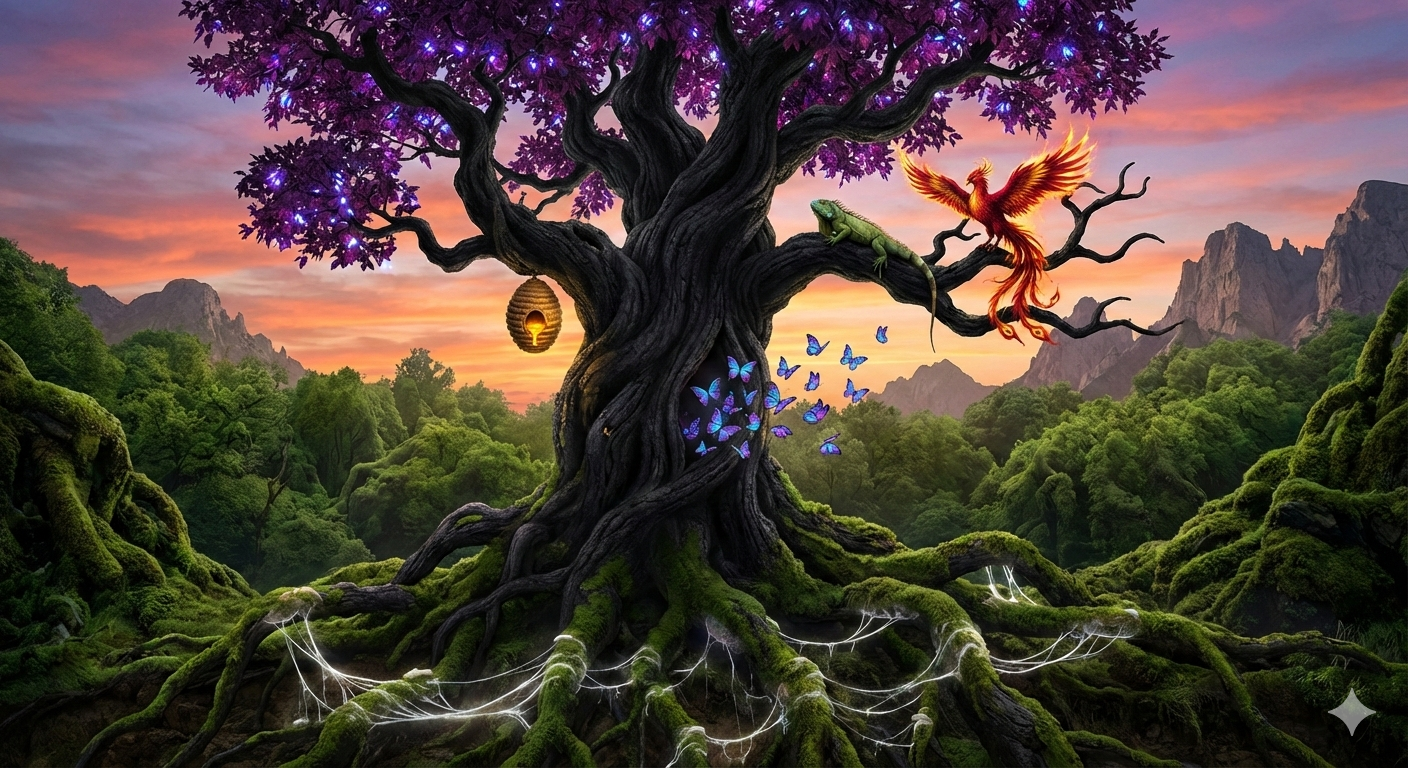
My own healing journey has found its form in a single, evolving image: a bare black tree that is slowly, deliberately, coming back to life.
The tree began as I felt—stripped bare, blackened, seemingly lifeless. There’s something honest about starting with that starkness, refusing to pretty up the devastation or skip ahead to the happy ending. That bare black tree acknowledges winter, death, the aftermath of fire. It doesn’t apologize for what trauma does—how it can leave us feeling hollow, exposed, rootless in our own lives.
But a tree, even a bare one, is never truly without potential. And this is where my tree stops being just an image of pain and becomes a map of intentional healing.
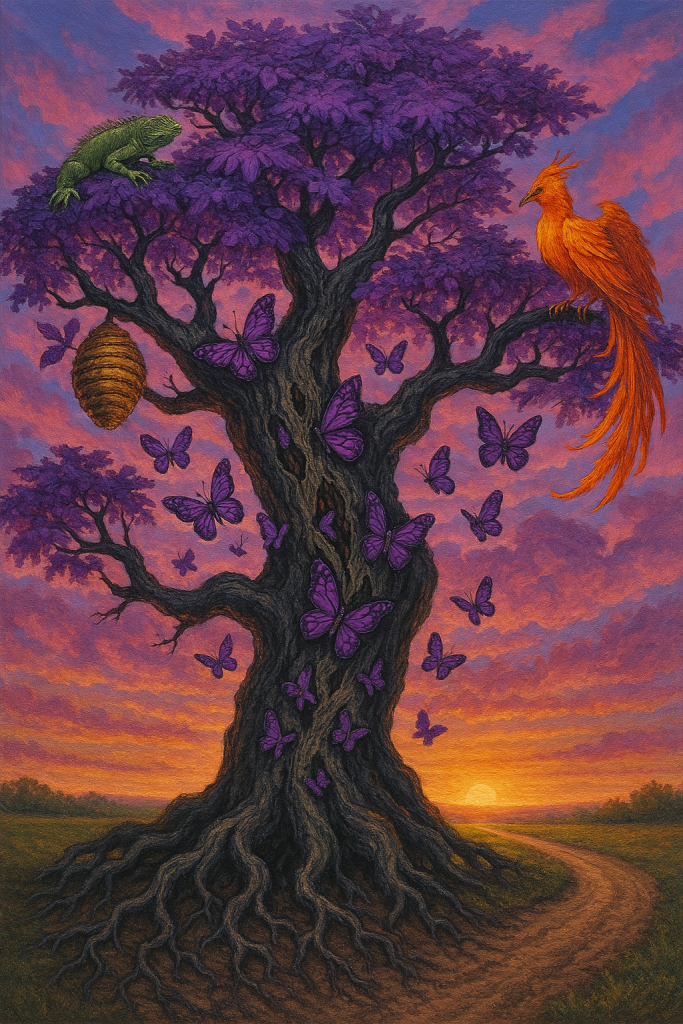
I am giving my tree purple leaves—not the green of ordinary growth, but purple. Purple for wisdom. Purple for creativity. Purple for the kind of knowledge that can only be earned through surviving what should have broken you.
These leaves represent my growth, yes, but not the simple, linear kind. They represent the paradox of trauma recovery: that we can grow precisely because of—and sometimes only after—our darkest seasons. Each purple leaf is a small act of reclamation, a choice to not just survive but to flourish in ways that honor both my wounds and my resilience.
The color itself matters. I could have chosen green, the expected color of new life. But purple speaks to transformation of a different order—the kind that transmutes pain into purpose, suffering into depth, experience into the kind of creativity that can only emerge when you’ve been broken open and reassembled yourself by hand.
My tree has strong, visible roots—not hidden underground, but proudly, necessarily displayed. These roots represent my values, the fundamental truths I’ve discovered about who I am and what matters most. They’re the things that held when everything else was shaking apart.
When trauma disrupts our sense of self, when abusers try to rewrite our identity, when we’re taught to abandon ourselves—roots are what save us. Values become anchors. They’re how we know ourselves again. They’re proof that beneath all that was done to us, beneath all we’ve endured, something essential remains.
These roots say: I know who I am. I know what I stand for. You cannot take this from me.
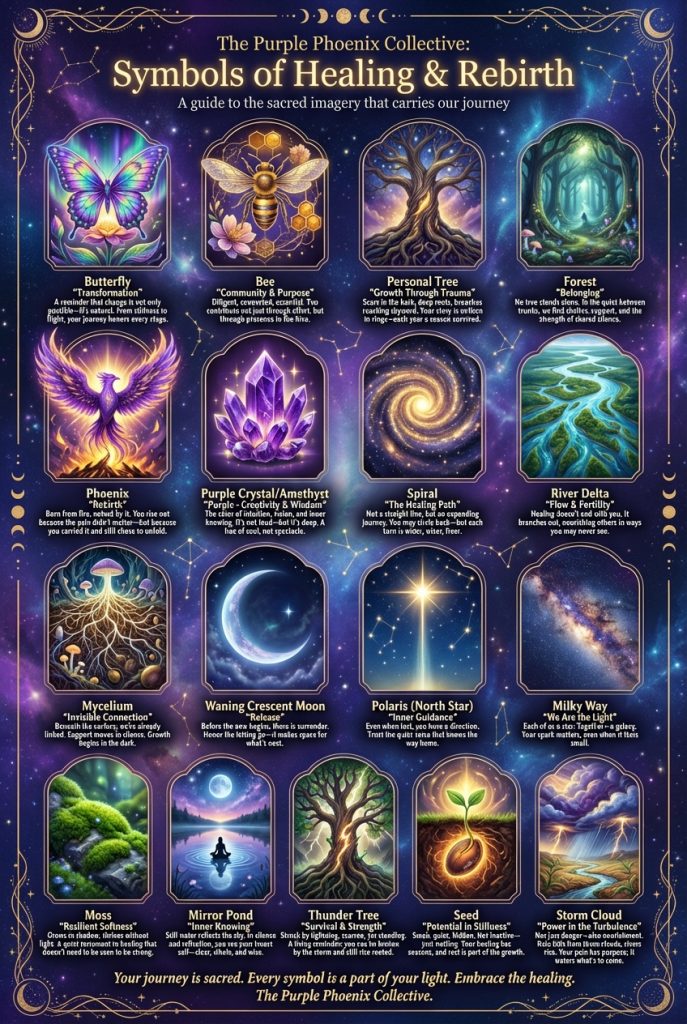
Nestled in my tree’s branches is a beehive—a thriving, buzzing symbol of community and, specifically, of my partner. His personal symbol is the bee, and so here he is, integrated into my healing landscape, a reminder that we don’t recover in isolation.
The beehive represents the sweetness that community can bring, the productive hum of connection, the way we build something together—cell by hexagonal cell—that is stronger than what any of us could construct alone. Bees are also fiercely protective, collaborative, essential to the ecosystem. They remind me that interdependence isn’t weakness; it’s how life actually works.
After trauma—especially trauma that involved betrayal by those who should have protected us—learning to trust, to let people in, to build community feels both essential and terrifying. The beehive in my tree says I’m doing it anyway.
In the branches, two creatures make their home: a phoenix and an iguana.
The phoenix is the obvious choice, perhaps—the mythological bird that dies in flames and rises renewed from its own ashes. It’s the universal symbol of rebirth, of cyclical transformation, of becoming something new precisely through the process of destruction. We’ve all heard the phoenix story, recognized ourselves in it when our lives burned down and we somehow, impossibly, rose again.
But the iguana—the iguana is personal.
I have a recurring dream where I find an iguana in my house, hidden away somewhere I’ve forgotten to look. The iguana is emaciated, dying, barely alive because I’ve neglected it so completely. This dream is devastating in its clarity: the iguana is me. The neglect is my own abandonment of myself—all the ways I learned to prioritize others’ needs, to minimize my own pain, to disappear inside my own life.
In my art, the iguana in my tree is healthy, vibrant, cared for. It represents the daily, unglamorous practice of self-care—the feeding and tending and paying attention that keeps us alive and well. The iguana doesn’t promise dramatic transformation like the phoenix. It promises something quieter and perhaps harder: the commitment to not abandon yourself, even when—especially when—you learned very young that you don’t matter.
Both creatures matter. We need the mythic rebirth and the daily dedication to our own wellbeing. We need the dramatic transformation story and the quiet morning ritual of feeding what lives inside us.
Butterflies emerge from the bark of my tree, and this is where symbolism becomes reclamation.
I had a high school teacher who taught environmental science. He groomed me. He took advantage of me. And he told me I was a butterfly, that I would make a beautiful transformation. He weaponized metaphor, turned something that should have been about nature and growth into a tool of manipulation and abuse.
For years, butterflies meant what he made them mean.
But here’s what healing through creativity allows: I get to take it back.
The butterflies emerging from my tree bark aren’t his anymore. They’re mine. They represent my reconnection to nature on my terms, my relationship with transformation that belongs to me, my reclamation of the natural world that he tried to taint with his abuse. These butterflies emerge from the tree itself—from my roots, my values, my chosen symbols—not from his narrative.
This is the radical power of creative healing: we can take the very symbols that were used to harm us and rewrite their meaning. We can refuse to let abusers own the metaphors of our lives.
Above my tree, in the distant sky, floats Chickenland.
When I was little, when the sunset turned pink and lavender, my grandfather would point to the clouds and tell me that was Chickenland—an imaginary place I populated with characters like Chicken Little and Popcorn, where I told elaborate stories about their adventures. It was pure, uncomplicated creativity. It was imagination before trauma taught me to be afraid of my own mind.
Chickenland represents my inner child before everything happened—the part of me that was curious, playful, inventive, free. It floats above my tree as both memory and promise: evidence that this creativity existed first, before it was complicated by survival, and evidence that it’s still accessible, still there in my sky.
We talk a lot in trauma recovery about “inner child work,” but it can feel abstract. Chickenland isn’t abstract. It’s specific. It’s mine. It’s the proof that before I learned to use metaphor for healing, I used it for pure joy. And maybe healing is, in part, finding our way back to that original creative impulse—not to erase what happened, but to remember who we were before, and to integrate that child into who we’re becoming.
The Winding Path: The Truth About Healing
Finally, there’s a path—winding, uncertain, fading into the distance.
This path is my rejection of the linear healing narrative. It’s my acknowledgment that recovery doesn’t follow a straight line, that we don’t simply “get better” and arrive at some fixed destination called “healed.” The path winds. It doubles back. It disappears into fog and uncertainty.
I still have a long road ahead. I don’t know what the future holds. And that’s not failure—that’s honesty.
The winding path says: this is ongoing. This is complex. This doesn’t resolve neatly. And that’s okay. That’s real. The path doesn’t promise arrival; it promises journey. It doesn’t offer certainty; it offers continued movement, continued choice, continued growth.
Why Symbols Matter: The Therapeutic Power of Metaphor
So why does any of this matter? Why create this elaborate symbolic landscape instead of just “dealing with” trauma more directly?
Because trauma often bypasses our language centers entirely. It lives in the body, in fragmented images, in sensations and nightmares that don’t organize themselves into coherent narratives. When we try to talk about it in plain language, we often find ourselves stuck, dissociated, or simply unable to access the depth of what we experienced.
But give someone a paintbrush, a lump of clay, a blank page, or in my case, a symbolic tree to populate—and suddenly things that couldn’t be spoken can be shown. Feelings that had no words find shapes. Experiences that felt chaotic and meaningless begin to organize themselves into a personal mythology that makes sense, that honors both pain and resilience, that creates meaning where trauma tried to destroy it.
Metaphor allows us to tell the truth slant, as Emily Dickinson wrote. We can approach our stories sideways, through symbol and image, in ways that feel safer and often more accurate than linear confession. We can hold multiple truths simultaneously—the bare black tree and the purple leaves, the dying iguana and the healthy one, the butterflies as wound and as reclamation.
Creative expression externalizes what lives inside us, making it visible, workable, transformable. Once my trauma exists as this tree, I can tend it. I can add to it. I can decide what grows there and what doesn’t. I can populate my own branches with the symbols of my choosing—community and self-care and reclaimed joy and honest uncertainty.
This is agency. This is authorship. This is taking back the pen—or brush, or camera, or whatever tool speaks to you—and writing the story yourself.
An Invitation to Your Own Symbolic Language
Your symbols won’t be mine. Your tree, if you have one, will bear different fruit, shelter different creatures, grow in different soil.
Maybe your healing image isn’t a tree at all. Maybe it’s an ocean, a house you’re rebuilding room by room, a garden where you’re learning which plants are actually weeds, a map of a territory only you can navigate, a cocoon in whatever stage of emergence feels true right now.
What matters isn’t the specific symbols but the practice of listening to what arises, trusting your own unconscious wisdom, and giving yourself permission to create a visual, metaphorical, symbolic language for experiences that defy ordinary words.
Pay attention to your recurring dreams—like my iguana. Notice what images you’re drawn to, what creatures or colors or landscapes keep appearing in your thoughts. Consider what was taken from you or tainted by trauma, and whether you want to reclaim it—like my butterflies. Think about who you were before, what you’re becoming now, and what the journey between those selves actually looks like—winding paths and all.
And then make something. Draw it, paint it, sculpt it, collage it, write it, dance it, build it. Make it as messy or as polished as it needs to be. Share it or keep it private. But make it yours.
Because when we create our own symbolic narratives, we’re not just making art. We’re making meaning. We’re making sense of the senseless. We’re making visible what was hidden, sayable what was silenced, bearable what once felt like it would destroy us.
We’re making ourselves—deliberately, symbolically, creatively—into people who survived and are choosing, branch by branch and leaf by purple leaf, to grow.
My bare black tree stands as both monument and living thing—evidence of what I survived and what I’m becoming. It changes as I change. It grows as I grow. And every time I add something new to its branches or roots or sky, I’m practicing the most radical act available to trauma survivors: I’m telling my own story, in my own language, on my own terms.
That tree is mine. This story is mine. And the healing, however winding and uncertain the path, is mine too.
Leave a Reply